Dr Beeching’s axe fell on Clare station in the 1960s. The tracks were taken up, anything of value was sold and the buildings were left boarded up and empty for many years. Thanks in large part to a National Lottery Heritage Fund grant, the main station building now houses a thriving cafe as well as the Park office, the former goods shed is a unique exhibition/reception venue, the South platform waiting room is a visitor centre and the stationmaster’s house has been renovated and rented as a private home, providing income to help maintain the Park.
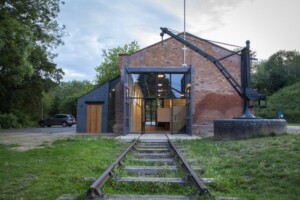
The Old Goods Shed
The railway was at Clare for a century and is a fascinating part of the town’s much varied history. Clare station is believed to be the only one in the world built within the bailey of a castle. The buildings are Grade II listed and were one of approximately 30 ‘Great Eastern Railway 1865 type’ stations built to a standard design. This type had complete architectural uniformity for all the station buildings, which even extended to the joinery and brickwork. Clare’s is the only surviving complex of the 1865 type. The signal box was sadly lost to a fire in the late 1960s, but the remaining buildings can be seen by visitors today.
History of the railway in Clare

Celebrating the cutting of the first sod for the railway at Clare, March 1863. Courtesy of Clare Ancient House Museum
During the boom years of railway expansion in England in the 1850s, plans were formed for a railway station in Clare. From Sudbury the route would go via Long Melford to Clare; in the other direction it extended to Haverhill and Cambridge. The Victorians had a rather different approach to conservation than we do today, so in 1862 the Great Eastern Railway began digging through the Norman bailey of Clare Castle and on 9 August 1865 Clare station opened with great ceremony.
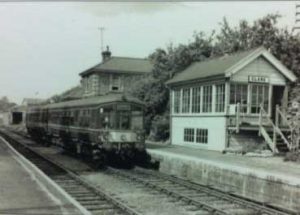
Clare Railway Station circa 1960
Grain, sugar beet, coal and passengers all used the station at Clare. At one time all the town’s coal came by train and the coal yard was part of a thriving goods yard transporting everything from cattle to holidaying residents’ suitcases.
One of the most important of the local grain merchants, Charles Byford, had their offices in Station Road. His firm had its own dock at King’s Lynn and sent much of their grain around the country from Clare station, as well as delivering to whisky distilleries in Scotland. During the 1950s as much as 80,000 sacks of grain passed through the station each year.
The advent of road traffic led to a drop in both passenger numbers and freight. Following the Beeching report, passenger services stopped on 6 March 1967, freight services ceased in 1966, and as early as 1963 the station had become an unstaffed halt.

Bridge over the Railway Line to the Mill
Still in place are the Stationmaster’s House with its ticket office and waiting room, a smaller waiting room across the tracks, and the last known 1865 goods shed anywhere in the country. The three buildings together as a group are very rarely found today. A crane of the 1865 type used to lift heavy goods has been installed by the goods shed from nearby Glemsford, replacing the original crane which was removed many years ago.
Visitors to the Park are surrounded by railway heritage. The Railway Walk begins by passing under the picturesque viaduct that carries the roadway to the former site of Clare Mill, destroyed by fire in the 1970s. The Victorian drainage still exists within the Park – some of it only discovered when 10,000 gallons of water disappeared from a pond overnight!
The smaller, South platform waiting room is now open Friday to Sunday from 11am to 3pm as a visitor centre. It includes pictures of and information about the railway at Clare. We are currently working on a video and booklet of local people’s memories of the station at Clare, which will be available to watch in the visitor centre shortly. We have also commissioned a scale recreation in “N gauge” of the station, which is due to be installed in the visitor centre later this year.
For more information about Clare Station please visit: http://www.disused-stations.org.uk/c/clare/